
NextMojo Pitch· London · Jun–Jul 2026LastGame Market· Tokyo · May 2025
Back to studio
한인타운 Case study · Place strategy

Six lines of brief. A three-year operating plan.

Aurora Sister Cities and the On Havana BID handed us a six-line brief — one vision, one mission, three goals — for the Korean district along Havana Street. We turned it into research, audiences, programs, technology, and a sequenced three-year marketing plan. Aurora kept us on for three more years.

Client
Aurora Sister Cities
On Havana BID
Location
Aurora, Colorado
Havana St. · H-Mart corridor
Engagement
2022 — 2025
Multi-phase, four mandates
Role
Strategy & programs
Field-research lead
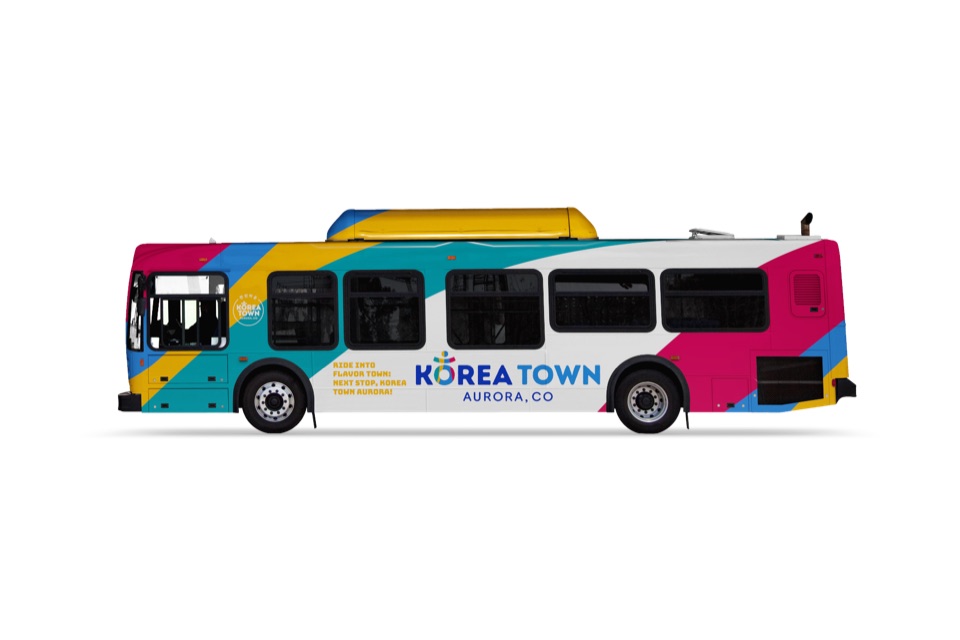
Korea Town Aurora brand applied to a city bus wrap along the Havana corridor
한인타운 KOREA TOWN AURORA — the identity in the wild, on the Havana Street corridor.
The problem

A Korean district hiding in plain sight.

Korea Town Aurora was already there. H-Mart anchoring Parker and Havana. Sixteen restaurant concepts from the corridor's unofficial mayor. A Korean population nearly double the Colorado average. A 33-year tie to Seongnam.

What it didn't have: a name a non-Korean Aurora resident could repeat. A landmark you'd drive across town to photograph. A reason for Buckley Space Force Base, Anschutz Medical, or Raytheon to think of it as anything other than lunch.

So when the RFP landed in 2022, we answered it as a place to be built — not a wordmark to be shipped.

6
Lines in the original brief — a vision, a mission, three goals
3-yr
Operating plan delivered, sequenced by year with KPIs and budgets
100
Community survey respondents, synthesized with Visit Aurora data
4
Data-driven audience personas with demographics and channel maps
The approach · Design thinking + placemaking

A place isn't a logo. It's a hundred conversations, stacked.

Cities usually get a brand book and a wave goodbye. We ran the full design-thinking loop under a placemaking discipline that says you build the place itself — not just its promotion.

01
Empathize

We asked the people who actually live here.

Before any pen touched paper: a community survey across Korean residents, business owners, and non-Korean Aurorans, plus stakeholder interviews with the ASCI Korea Working Group, BID directors, and the restaurateurs who built the corridor. The answer that set the tone — locals wanted the district to feel legitimate before it felt grand. Start small, but real.

02
Define

Go see. Steal smart, not lazy.

We led field visits to Koreatown LA and Koreatown Orange County with the On Havana BID and ASCI boards in tow — and added a stop at Seongnam City's business center to make the sister-city connection literal. Every observation was written back to the plan, page by page, in a ten-page implementation report.

03
Ideate

"Aurora's Passport" — a campaign with a backbone.

Credit where it's due: the Korea Town Aurora brand mark was already in place, built by a talented local designer — our scope was the strategy around it. We authored the umbrella campaign — "Aurora's Passport: Discover the Cultural Gem of Colorado" — architected to evolve across years and topics, plus named programs: Bibimbap Food Week, the Mascot Contest, the Daesa Program, a K-AI chatbot, and the Moonshot landmark.

04
Prototype

Make the strategy something you can see.

A 7-section website architecture with a Korean / English / Spanish trilingual layer and an OpenAI chatbot fine-tuning spec; four public-art landmark options (Korean Drum, Interactive Janggu, Hanok Gate, a mural program); event collateral and price modeling for Bibimbap Food Week — concepts pushed into the contexts they'd live in, so stakeholders could vote on something real.

05
Implement

A plan that talks economics, not just aesthetics.

The deliverable wasn't a brand book. It was a three-year marketing plan tied to an Aurora–Seongnam economic strategy — linking Aurora's aerospace, defense, and medical employers to Seongnam's Pangyo Techno Valley. And we never fully left: we still send same-day briefings when a competitor moves.

Who we built for

Four people, not one audience.

The survey resolved into four data-driven personas. Every program in the plan is aimed at one of them by name.

Urban Foodie

Hunts new flavors and gastrodiplomacy. Drives the Bibimbap Food Week strategy.

Cultural Maven

Festivals, art, heritage. Anchors the Chuseok and Lunar New Year programming.

Serenity Seeker

Wellness, K-beauty, slow visits. The audience for the Local Guides program.

Thrill Enthusiast

Events, nightlife, landmarks. The Moonshot Project is built for them.

It was excellent — and you clearly put lots of work into it. We heard nothing but compliments from all who attended.
— Becky Hogan · Aurora Sister Cities, after the field-research report
The three-year plan

Foundations. Culture. Legacy.

Every phase has named programs, defined KPIs, and a recurring spine of events. Here is how the plan sequences across three years.

Year One

Foundations & awareness

  • Korea Town Aurora Hub website
  • Social launch — FB, IG, X
  • Content-marketing engine
  • Local engagement events
  • PR campaign
  • Annual Korea Town golf tournament
Year Two

Expansion & engagement

  • Korea Town mascot launch
  • Bibimbap Food Week (Chuseok)
  • Mascot design contest
  • Lunar New Year & Chuseok festivals
  • Tourism & travel partnerships
  • Branded merchandise drops
Year Three

Sustainability & legacy

  • The Moonshot Project — drum landmark
  • Daesa Program — micro-influencers
  • Local Guides program
  • K-AI immersive cultural layer
  • Global digital outreach
  • Audio Bursts storytelling
On the street

The system, applied.

What we left behind

Six things Aurora still has.

01 · Identity

A district with a story

From "the area near H-Mart" to a named, branded district with a published positioning, four target personas, and a three-year operating plan.

02 · Icons

Landmarks on the table

The Moonshot drum and the Hanok gate gave Aurora something to fundraise around. Public art is the cheapest place identity money can buy.

03 · Economics

A pipeline to Pangyo

The Aurora–Seongnam analysis bridged cultural exchange to economic development — and a model for a Korean Innovation & Cultural Center near H-Mart.

04 · Method

A field-research playbook

The LA and Fullerton visits became a methodology the city can re-run for any cultural district — without reinventing the work.

05 · Alignment

Stakeholders, aligned

ASCI, the On Havana BID, the Korea Committee, and city economic development arrived at the same plan — not the same compromise.

06 · Tenure

A standing advisor

The relationship didn't end at delivery. Three years, four mandates, and ongoing — including adjacent work like the Korean War Memorial concept.

We treated the district like a product. With users.

Start a conversation
By introduction · Los Angeles · Portland · Barcelona
© Zucchi Studio MMXXVI · Korea Town Aurora · Aurora Sister Cities & On Havana BID← Back to studio